
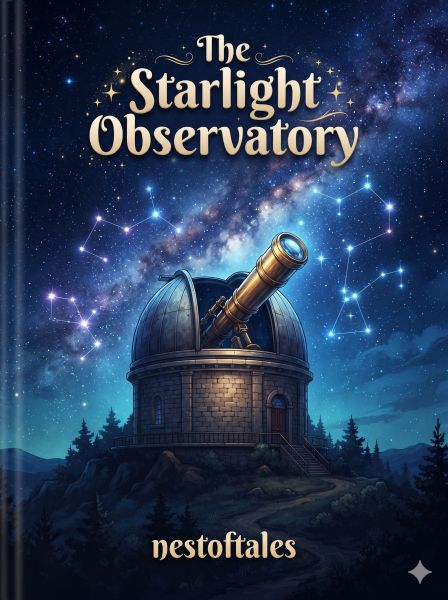
The Starlight Observatory
Episode 3: The Lunar Crater
With the observatory fully operational and the family reunited, Lyra, Orion, and Julian turned their attention back to active astronomical research. Their first major project was a high-resolution photographic survey of the lunar south pole, specifically focusing on shadowed impact craters. Lyra operated the digital imaging systems attached to the great refractor, while Orion and Julian managed the telescope tracking drives. As the moon drifted across the crosshairs of the eyepiece, a breathtaking expanse of rugged craters, mountains, and plains appeared on their monitors. They focused on Shackleton Crater, a massive, permanently shadowed depression suspected of harboring ancient water ice deposits. “The spectrometer readings show clear spectral signatures of hydrogen-rich compounds inside the crater floor,” Lyra announced triumphantly, saving the data files. Orion leaned over her shoulder, marveling at the crystal-clear lunar imagery streaming onto their high-definition screens from the dark void of space. “Your optical modifications made all the difference, Julian; we couldn’t resolve this detail before,” Orion credited his brother. Julian smiled, adjusting the fine-focus knob with practiced ease as the moon drifted gracefully across the stellar background. The lunar crater survey gained national attention, placing the Starfall Observatory back at the forefront of astronomical discovery. It was a stunning vindication of their perseverance, scientific skill, and reconciled family partnership.
The Dark Sector
Encouraged by their lunar success, the observatory team embarked on a deep-space imaging campaign targeting the elusive Dark Sector of the Milky Way. This obscured region of space, choked with dense cosmic dust and interstellar gas clouds, hid the formation of newborn star systems from standard view. Lyra calibrated the infrared sensors to pierce through the thick dust veils, while Julian fine-tuned the telescope’s adaptive optics to correct atmospheric distortion. For three consecutive nights, they worked through freezing mountain temperatures, capturing gigabytes of invisible infrared data streaming from distant sectors. As the computer algorithms processed the raw imagery on the fourth morning, a magnificent stellar nursery emerged on the central monitor. Hundreds of glowing protostars, surrounded by swirling protoplanetary disks of dust and gas, were revealed in stunning, unprecedented clarity. “We’re looking at solar systems being born in real time,” Orion whispered in absolute reverence, staring at the screen with tears in his eyes. Julian and Lyra stood beside him, sharing a quiet, triumphant embrace as the cosmic masterpiece materialized before them. The Dark Sector had yielded its deepest secrets to their combined ingenuity, proving that teamwork could conquer any obstacle. The observatory was no longer just a struggling relic of the past, but a shining beacon of modern scientific exploration.