
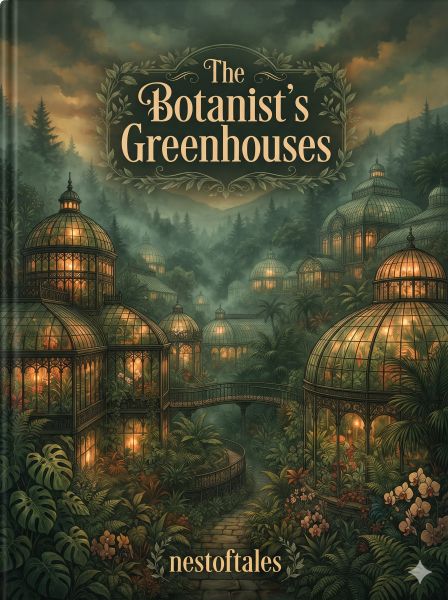
The Botanist's Greenhouses
The characters and events in this story are entirely fictitious. They do not resemble anyone, and any resemblance to any region or real-life persons is purely coincidental.
Episode 1: The Withered Stem
Deep within the misty ravines of the Emerald Highlands stood the Victorian glasshouses of botanist Dr. Alistair Thorne, famous for cultivating rare alpine flora. His daughter, Rowan, a twenty-four-year-old botanical illustrator with an encyclopedic knowledge of plant pathology, tended the specimen tables. Today, however, an ominous silence hung over the humid nursery as Rowan inspected a prized Himalayan blue poppy whose central stem had withered. She knelt beside the galvanized steel bench, using a magnifying glass to examine the blackened base of the drooping, discolored stalk. “The soil moisture is optimal, yet the vascular system is collapsing from the root upward,” Rowan muttered anxiously, adjusting her wire-rimmed glasses. Her father walked down the gravel aisle carrying a watering lance, stopping abruptly when he saw the distressed specimen on the table. Dr. Thorne sighed heavily, leaning on his wooden cane as his weary eyes surveyed the ailing flower with deep professional sorrow. “That poppy represents five years of selective breeding from high-altitude seeds collected during my expedition to the northern peaks,” Alistair said softly. Rowan carefully snipped a cross-section of the withered stem, placing it on a glass slide to examine under her work microscope. “It’s not a watering error or a fungal rot, Dad; the cellular walls are bursting from an unknown toxin in the greenhouse water supply,” she diagnosed. Alistair frowned deeply, knowing that a contaminated water line threatened every rare specimen housed beneath their historic glass panes. They immediately set to work tracing the intake valves back to the mountain spring source, determined to save their botanical legacy. The withered stem served as a chilling warning that a hidden danger had infiltrated their carefully controlled paradise.
The Rare Seed
Following the discovery of the toxin, Rowan and Alistair spent the entire morning testing water samples from every spigot and cistern in the greenhouse complex. They finally isolated the contamination to a single outdoor runoff pipe near the northern boundary wall where local agricultural fertilizers had leaked. After flushing the entire irrigation system with pure spring water, Rowan turned her attention back to the laboratory bench to salvage what remained. Resting on a Petri dish before her was a tiny, dormant seed pod harvested from the withered Himalayan blue poppy before it succumbed. The seed was smaller than a grain of sand, possessing a hard, chitinous outer shell that required precise scarification to germinate. Using a micro-needle under high magnification, Rowan carefully scored the outer coating without damaging the delicate embryonic leaves inside. Alistair stood behind her, watching her steady hands with immense pride and quiet tension. “If this seed fails to sprout, the entire highland strain is lost forever,” Alistair reminded her gently. Rowan nodded, planting the scarified seed in a specialized nutrient agar tray infused with sterilized mountain loam. She placed the tray inside the germination chamber, setting the automated thermostat to a constant sixty-two degrees Fahrenheit with simulated twilight cycles. “Now we wait for nature to decide whether our efforts were enough,” Rowan whispered, stepping back from the incubator. They spent the rest of the afternoon sealing the greenhouse perimeter against further agricultural runoff from neighboring properties. The rare seed rested in the dark warmth of the chamber, holding the fragile hope of their botanical sanctuary within its microscopic walls.