

The Botanist's Greenhouses
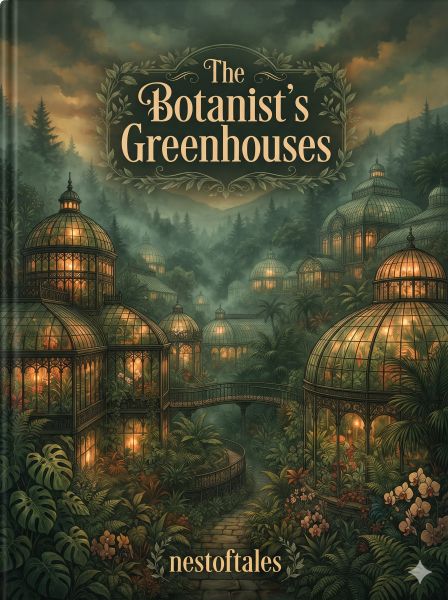
Episode 3: The Green Canopy
Over the next several weeks, the tiny alpine sprout grew at an astonishing rate under Rowan’s meticulous care and scientific oversight. Its stem thickened into a sturdy, silver-green stalk, crowned with broad, velvety leaves that arched gracefully toward the artificial sun. The green canopy formed by the mature plants in the primary conservatory now flourished with renewed vigor, completely recovered from the earlier toxin scare. Visitors from the provincial botanical society began booking weekend tours once again, marveling at the vibrant biodiversity preserved within the historic glasshouse. Rowan spent her afternoons sketching the new poppy’s leaf structures for her scientific journal, capturing every fine vein with delicate watercolor washes. Alistair focused on cataloging the incoming seed exchanges from international research stations, securing the conservatory’s global reputation. Standing together beneath the towering fronds of ancient tree ferns, father and daughter shared a quiet moment of profound professional satisfaction. “The conservatory has never looked greener or more vibrant in all my years as director,” Alistair reflected proudly. Rowan smiled, looking up at the sunlight filtering through the magnificent green canopy overhead. “We didn’t just save a collection, Dad; we cultivated a living archive for future generations,” Rowan replied softly. Their sanctuary stood as a beacon of scientific perseverance high above the misty mountain ravines.
The Soil Sample
Despite the flourishing canopy, Rowan remained vigilant, knowing that ecological balance in a closed greenhouse environment was fragile and easily disrupted. She instituted a rigorous weekly soil testing protocol, analyzing mineral content, pH levels, and microbial activity across every planting bed. During a routine scan of the southern fern gyp-rock beds, she noticed an abnormal spike in soil acidity that threatened root health. She immediately collected a comprehensive soil sample, rushing back to her laboratory bench to run chromatographic separations. The test results revealed an unexpected buildup of sulfur compounds leaching upward from the foundation bedrock beneath the aging stone masonry. “We have a slow geochemical leak in the sub-foundation drainage tiles,” Rowan reported to her father with a concerned frown. Alistair examined the chemical breakdown sheets, nodding in agreement with her precise analytical conclusions. “The original clay drainage pipes are breaking down after seventy years underground; we need to excavate before root rot sets in,” Alistair decided. Working together over the next three days, they carefully dug up the affected pathways, replacing the crumbling clay tiles with modern PVC drainage channels. The soil sample analysis had averted a silent agricultural disaster before any visible damage could touch the plant roots. It highlighted Rowan’s vital role not just as an illustrator, but as the analytical guardian of the entire botanical estate.