

The Clockwork Eclipse of Oakhaven
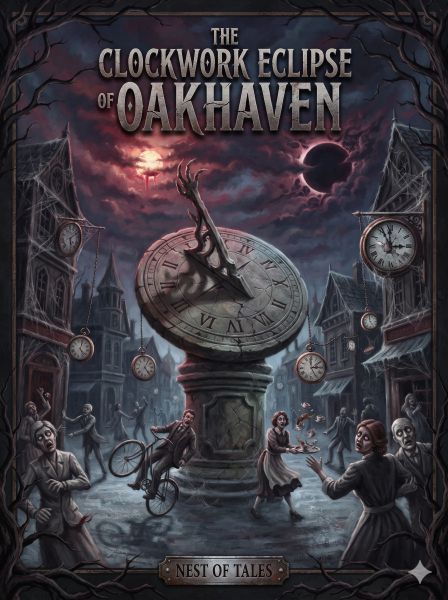
The characters and events in this story are entirely fictitious. They do not resemble anyone, and any resemblance to any region or real-life persons is purely coincidental.
Episode 1: The Gear That Stopped Turning
The heavy scent of burning whale oil and aged brass hung thick in the subterranean basement workshop of Oakhaven Clockworks, where master horologist Master Barnaby Finch sat hunched over a workbench illuminated by a solitary, green-shaded gas lamp. Outside, the rain lashed furiously against the thick, iron-grated street-level windows, sending distorted shadows dancing across the stone walls like frantic, faceless spirits. Barnaby was a man whose entire existence was bound to the rhythmic cadence of escapements, balance wheels, and anchor pallets, measuring his life in precise sixty-second intervals. Yet tonight, the steady, comforting symphony of a hundred ticking clocks had been shattered by a single, terrifying anomaly that emanated from the deepest corner of the cellar. The master tower clock of the municipal district—a colossal, six-ton iron-and-brass monstrosity known as the Great Engine, which had governed the waking and sleeping hours of Oakhaven for over two centuries—had suddenly and inexplicably seized up at precisely 11:42 PM. Barnaby wiped a smear of black machine grease from his weathered forehead with the back of a calloused hand, his fingers trembling as he picked up his brass-rimmed magnifying loupe. He approached the towering iron housing of the Great Engine, casting a long, wavering beam of yellow light from his kerosene lantern into the dark, labyrinthine interior of the machinery. The massive escape wheel, a five-foot-diameter gear of forged steel teeth, hung frozen mid-rotation, wedged against the pallet arms as if trapped in invisible stone. But as Barnaby leaned closer to inspect the teeth, his breath caught in his throat, and a cold, prickling sweat broke out across the back of his neck. The obstruction jamming the gear was not a broken pivot, a slipped spring, or a fallen screw; it was a human hand—a child’s hand, grayish-white and petrified into solid bone, protruding directly out from the solid cast-iron housing as though the metal itself had grown around the flesh decades ago. Barnaby stumbled backward, his boot heel catching on a stray pile of spare brass washers, and he hit the stone floor with a dull thud, dropping his lantern. The glass cracked with a sharp snap, spilling a pool of burning oil across the flagstones that quickly flared into an angry, licking tongue of fire. In the sudden, erratic illumination of the flames, the petrified fingers inside the gear twitched—not in a mechanical shudder, but with a deliberate, clawing motion—and the Great Engine emitted a low, wet, organic groan that sounded uncomfortably like a human throat clearing itself in the dark. Barnaby scrambled frantically toward the wooden cellar stairs, his heart hammering against his ribs like a trapped bird, but before his hand could grasp the iron latch, the heavy basement door slammed shut from above with a deafening crash, locking itself from the outside with a heavy iron bolt that slid home into place all by itself. He spun around in absolute panic as every single clock in the workshop—hundreds of them, from pocket watches to grandfathers—simultaneously began to tick backward at a manic, frenzied pace, counting down toward a midnight that he instinctively knew he would never survive.
The Shadow Over Brass Square
The swirling, coppery fog that rolled off the marshlands of Oakhaven every autumn evening usually carried the faint, distant scent of salt and decaying peat. Tonight, however, the mist smelled of scorched wool, stale copper coins, and something sickeningly sweet, like overripe plums left rotting in the cellar. Across the gas-lit cobblestones of Brass Square, city watchman Timothy Vane walked his solitary midnight beat, his heavy wool cloak swishing against his boots with a dry, rhythmic hush. Timothy was a pragmatic, weary man who trusted nothing that could not be weighed, measured, or locked behind an iron door, yet tonight the familiar square felt utterly alien. The towering Victorian townhouses surrounding the plaza were wrapped in darkness, their slate roofs blending into a sky the color of bruised iron. Not a single carriage rattled over the stones, and the gas lamps flickered weakly, casting long, writhing shadows that stretched across the pavement against the natural direction of the light. Timothy paused beneath the central monument—a massive, corroded bronze statue of the city’s founder holding aloft a mechanical astrolabe—and pulled his silver pocket watch from his waistcoat to check the hour. As he flipped open the case, the watch face did not display the time; instead, the tiny gold hands were spinning wildly in circles, while the enamel dial began to sweat a thick, black oil that stained his thumb. Suddenly, the massive bronze shadow cast by the founder’s statue detached itself from the metal base, sliding down the stone pedestal like a puddle of wet ink onto the cobblestones. Timothy froze, raising his heavy police lantern and stepping back against the monument. The detached shadow did not disperse in the lantern light; instead, it rose upward, elongating into a towering, humanoid silhouette with disproportionately long arms ending in jagged, gear-like appendages. The thing had no facial features, yet it radiated an intense, suffocating aura of malevolent hunger that froze the marrow in Timothy’s bones. He opened his mouth to shout a challenge, but no sound came out—his throat felt as though it had been tightly packed with dry watchmaker’s sand. The shadow glided toward him across the square with terrifying speed, its movements accompanied by the sickening sound of wet gears grinding together inside an unseen cavity. Timothy scrambled backward, tripping over a cast-iron drain grate, and hit the stone pavement hard as the towering darkness lunged over him, blotting out the stars and plunging the entire square into an absolute, lightless void where the only sound was the slow, deliberate ticking of his own failing pulse.