

The Clockwork Eclipse of Oakhaven
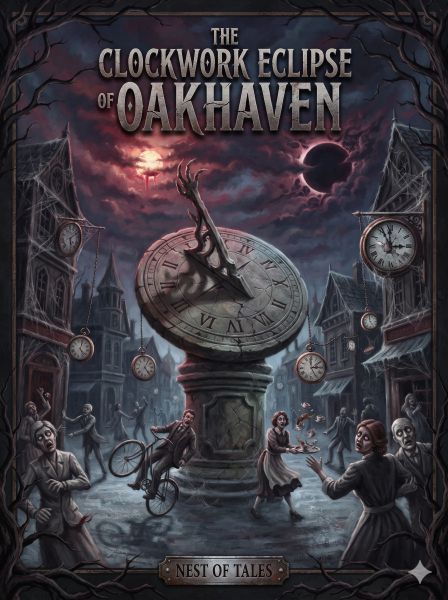
Episode 02: The Watchmaker’s Secret Notebook
Deep within the dusty, cobweb-laden attic of an abandoned clock shop on Gallows Lane, apprentice archivist Clara Vance carefully lifted the rotting leather cover of a hand-bound folio labeled simply as The Ledger of Unmade Hours. The attic was illuminated only by a thin beam of moonlight cutting through a cracked skylight, casting pale silver bars across stacks of discarded clock dials, broken mainsprings, and jars of dried animal tallow. Clara had been hired by the municipal estate bureau to catalog the belongings of Master Horologist Alistair Finch—the man who had vanished from his workshop forty years ago under deeply mysterious circumstances. As she turned the brittle, yellowed pages of the notebook, she noticed that the handwriting shifted dramatically halfway through the volume. The early entries were neat, meticulous records of gear ratios and escapement designs, but the later pages dissolved into frantic, obsessive scrawls filled with unsettling anatomical sketches and bizarre equations mapping out the mechanics of human pain. One particular page featured a detailed, cross-section drawing of a human ribcage modified to house a fully functional escapement anchor and pendulum bob, captioned in jagged ink: “The heart is merely an inferior spring; it winds down too quickly, so we must forge a better pendulum from the spine.” A sudden, icy draft swept through the attic, causing the skylight to rattle violently in its wooden frame and extinguishing the small candle Clara had set upon the desk. Plunged into sudden darkness, she reached instinctively for her pocket flashlight, clicking the switch with a nervous thumb. The beam cut through the dust-motes, illuminating the desk before her—and to her absolute horror, the pages of the open ledger were turning themselves. Faster and faster the dry parchment flipped over, driven by an invisible breeze, until the book slammed shut with a sharp, echoing clap. From the pitch-black shadows beneath the eaves of the attic, a rhythmic, metallic clicking began to sound—click, click, click—slowly creeping closer across the floorboards toward where she sat paralyzed, accompanied by the distinct, dragging sound of a heavy brass pendulum swinging through the dark.
The Pendulum That Kept Two Times
The grand vaulted gallery of the Museum of Horology was supposed to be closed to the public on Mondays, but night custodian Julian Thorne was trapped inside by a malfunctioning electronic security gate that had locked down at midnight. The vast, marble-floored hall was filled with the ticking of a thousand historic timepieces, creating a dense, overwhelming cacophony that sounded like a million tiny metallic heartbeats echoing off the stone walls. In the exact center of the gallery stood the exhibition’s centerpiece: the Goliath Pendulum, a twelve-foot-tall brass-and-ebony grandfather clock housing a massive, polished silver bob that swung back and forth in a slow, hypnotic arc. Julian sat at his folding security desk near the entrance, rubbing his tired eyes and trying to ignore the oppressive atmosphere of the museum at night. For the past hour, however, he had noticed a profound acoustic anomaly within the hall. The Goliath Pendulum was ticking at two entirely different tempos simultaneously. The massive silver bob swung to the left with a deep, sonorous tock that resonated through the floorboards every three seconds, while a second, sharper tick echoed from inside the wooden case at an erratic, frantic pace of six times per second. Julian stood up, grabbed his heavy iron flashlight, and walked down the marble aisle toward the towering clock, his boots echoing sharply in the quiet hall. As he drew near, he saw that the glass door of the clock case was unlocked, slightly ajar by a fraction of an inch, leaking a thin wisp of warm, sulfur-scented air into the chilly room. He reached out with a trembling hand, gripped the brass handle, and pulled the glass door wide open to inspect the pendulum mechanism. Inside the dark wooden housing, behind the swinging silver bob, stood a second, smaller pendulum—one forged not from brass or steel, but from a human arm, skinless and glistening with fresh arterial blood, swinging rhythmically on a joint of bone. Before Julian could scream, the silver bob of the main pendulum violently reversed its arc, snapping forward with immense force and pinning him against the marble pillar behind the display, while the second pendulum inside the case began to beat against his ribs in frantic synchronization with his own dying heartbeat.