

The Clockwork Eclipse of Oakhaven
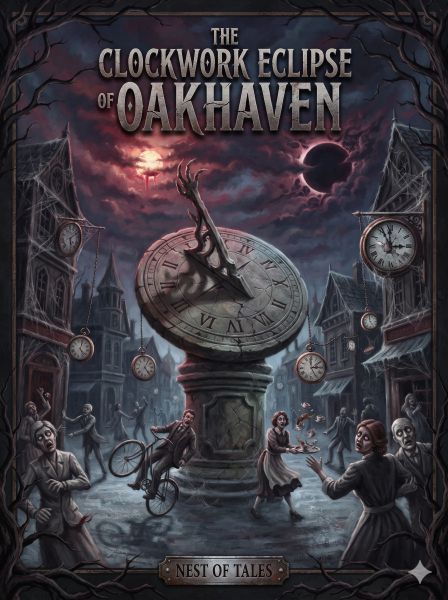
Episode 04: The Brass Key in the Dust
The damp, cluttered basement storage room of the Aethelgard Municipal Archive smelled of rotting cardboard, vinegar-syndrome film reels, and decades of accumulated attic dust. Archivist Orson Thorne knelt on the cold concrete floor, shining his penlight into the dark space beneath a row of heavy iron shelving units. He was searching for a missing箱 of nineteenth-century tax ledgers when his fingers brushed against something hard, cold, and distinctly metallic buried beneath a thick drift of gray silt. He pulled it out into the light: a heavy, six-inch-long brass key featuring an intricate, multi-toothed bit shaped like a complex gear train, its bow inscribed with the crest of the defunct Oakhaven Orphanage. Orson wiped the dust from the metal with his sleeve, noticing that the brass was unnaturally warm to the touch, pulsing with a faint, rhythmic vibration that sent a slight tingling sensation up his arm. Curious, he checked the archive’s index registers for any record of a lock matching such a peculiar key, but found no mention of it in any cataloged document. He stood up, pocketed the key, and decided to check the old basement doors leading to the sealed coal cellars—areas of the building that had been bricked off since the 1920s. Following the faint vibration in his pocket like a compass needle, he walked down the dimly lit service corridor until he reached a stretch of foundation wall where the original granite blocks had been covered by a thick, seamless slab of modern concrete. Yet, set directly into the center of that solid concrete wall was a single, freshly oiled keyhole that gleamed in the dim light. Orson hesitated for only a second before stepping forward and inserting the heavy brass key into the slot. With a smooth, effortless turn that defied the solid stone surrounding it, the key clicked into place. The entire concrete wall groaned, splitting down the middle like a dried scab to reveal a narrow, pitch-black stairwell leading downward into the earth, from which billowed a thick cloud of dust containing the distinct, echoing sounds of children crying in the dark.
The Map of Forgotten Ticks
Cartographer and historical surveyor Silas Thorne spread a massive, ink-stained linen map across his drafting table in the municipal planning office of Neo-Veridia. The map was an extremely rare artifact—a pre-war transit survey of Oakhaven’s subterranean utility and sewer infrastructure, annotated in the margins with microscopic handwriting by an anonymous Victorian engineer. Silas was attempting to map the exact locations of several old underground steam-valve hubs that had been lost during the post-war reconstruction projects. Yet, as he examined the ink lines under his magnifying lamp, he realized the map was depicting something far more disturbing than drainage pipes and water mains. The red ink lines did not trace physical tunnels; they mapped out a sprawling, continent-wide network of acoustic resonance nodes, connecting every major church bell tower, municipal clock, and industrial steam whistle into a single, cohesive geometric web centered directly beneath the ruins of the old clockworks. A series of tiny X marks drawn across the map were accompanied by precise timestamps, all ending in the exact same minute: 3:33 AM. Silas picked up his red pen, intending to mark the coordinates on his modern digital terminal, but as the pen nib touched the linen, the red ink on the map began to crawl across the fabric like living blood, rearranging the street names and tunnel routes into a brand-new configuration. The lights in the planning office flickered and died, plunging him into darkness save for the pale glow of his terminal monitor. From inside the metal drawers of his filing cabinet, a frantic, synchronized clicking began to sound—hundreds of small metal springs and gears winding themselves up inside the locked steel drawers, ticking in unison toward the approaching hour of 3:33 AM.