
The Clockwork Eclipse of Oakhaven
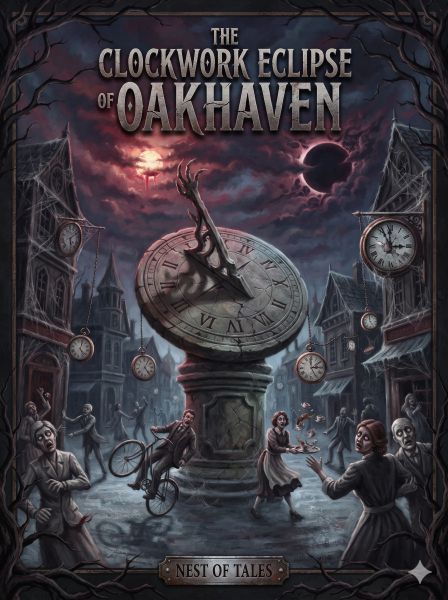
Episode 05: The Meeting at Midnight Spring
Deep within the dense, mist-shrouded woods of the Blackwood Forest, far beyond the furthest municipal boundary stone of Oakhaven, folklorist and amateur historian Dr. Alistair Vance pushed his way through a thick wall of briars and brambles. He carried a heavy canvas rucksack containing audio recording equipment, a compass, and a battery-powered lantern, following the vague directions found in the margins of the Watchmaker’s Secret Notebook. The night was deathly still, devoid of crickets, owls, or the rustle of wind in the pine branches; the only sound was the crunch of frozen twigs beneath his boots. According to the ancient local rumors, a subterranean spring known as Midnight Spring bubbled up from the bedrock at the stroke of twelve every hundred years, and those who drank from its waters were granted visions of the city’s true, mechanical foundation. Alistair checked his watch; it was 11:58 PM. He pressed forward through the gloom until he broke out into a small, perfectly circular clearing surrounded by towering, dead oak trees whose branches twisted upward like clawed hands. In the center of the clearing sat a shallow stone basin filled with dark, motionless water that mirrored the starless sky above. As Alistair approached the basin, the digital display on his watch flashed from 11:59 to 12:00, and the water in the spring abruptly began to boil without heat, churning with thousands of tiny, metallic bubbles that rose to the surface and burst into showers of glowing amber sparks. From the surrounding darkness of the dead oak trees, twelve tall, silent figures stepped into the clearing. They wore heavy Victorian overcoats and top hats, but when the amber light of the spring illuminated their faces, Alistair dropped his audio recorder in sheer horror: they had no eyes, no noses, no mouths—only smooth, polished disks of brass set into their skulls where human faces should have been, turning slowly in opposite directions as they advanced toward him around the bubbling water.
The Glass Dial That Cracked
Inside the high-altitude optical laboratory of the Aethelgard Observatory, master lens-grinder and precision instrument maker Dr. Thalia Vance worked under the intense focus of an adjustable halogen lamp. Before her on a velvet-lined turntable rested the Master Dial—a massive, twenty-four-inch circular plate of ultra-pure, optical-grade quartz crystal intended to serve as the central face for the new municipal astronomical clock. Thalia was putting the final polish on the crystal surface, using a fine cerium-oxide compound to remove microscopic imperfections. The observatory was perched on a lonely mountain peak, surrounded by swirling alpine gales that rattled the massive glass dome overhead. As she polished, her eyes drifted to the outside world through the clear dome, where the full moon hung low in the sky, casting an eerie, milky glare across the snowy ridges. Suddenly, a sharp, metallic ping echoed through the laboratory, stopping her hand mid-stroke. Thalia set down her polishing pad and stared at the quartz dial on the turntable. Across the center of the flawless crystal face, a single, hairline fracture had spontaneously appeared, cutting from the twelve o’clock position straight down to the six. She reached out with a trembling finger, touching the cool surface of the glass, but as her skin made contact with the fracture line, the crack widened violently with a sound like breaking ice. A web of jagged fissures raced across the dial in milliseconds, shattering the quartz into thousands of razor-sharp fragments that exploded outward from the turntable. Thalia threw her arms over her face, ducking beneath the workbench as a hailstorm of crystal shards shredded her lab coat and embedded themselves in the wooden walls. When the silence returned, she cautiously raised her head and looked back at the turntable. The broken glass fragments were reassembling themselves on the velvet pad—not into a circular clock dial, but into the exact shape of a human skull whose empty eye sockets stared up at the domed ceiling as the observatory’s massive roof doors slowly creaked open to the night sky.