
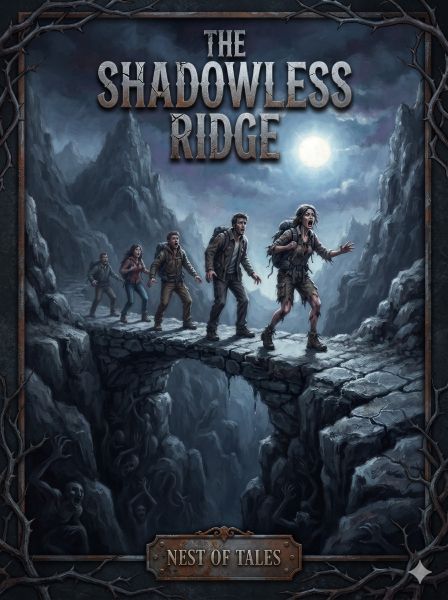
The Shadowless Ridge
The characters and events in this story are entirely fictitious. They do not resemble anyone, and any resemblance to any region or real-life persons is purely coincidental.
Episode 1: The Foot of the Bare Mountain
The low, rumbling hum of the rented off-road truck died away as Dr. Thaddeus Holt cut the ignition, letting the heavy diesel engine cool with a series of metallic pings in the damp air. They had arrived at the absolute boundary line of civilization, where the rough gravel road degenerated into an ancient track of gray shale and matted mountain moss. Ahead of them rose the stark, forbidding slope of Mount Oros—a geological aberration known locally as the Bare Mountain because not a single tree, shrub, or blade of grass managed to cling to its sulfurous, bleached limestone flanks. Thaddeus adjusted his wire-rimmed spectacles, wiping a smudge of dust from the lens as he squinted upward through the windshield at the jagged peak cutting into the gray afternoon sky. Beside him in the passenger seat, his expedition partner, a seasoned topographic surveyor named Caleb Vance, was frantically checking the dials of his magnetic compass. Caleb’s face was pale, his brow beaded with a cold sweat that had nothing to do with the chilly alpine temperature seeping through the vehicle’s floorboards. “The needle isn’t just fluctuating, Thaddeus,” Caleb whispered, his voice trembling as he tapped the glass face of the instrument with a fingernail. “It’s spinning clockwise at high speed, as if something massive and magnetic is buried directly beneath our tires.” Thaddeus unbuckled his safety harness, grabbed his heavy leather field journal from the dashboard, and pushed open the creaking door to step out onto the desolate earth. The ground beneath his boots felt unnaturally hard, devoid of the soft give of organic soil, vibrating with a low, sub-audible frequency that made his teeth ache. They were here to investigate the sudden, unexplained disappearance of a government meteorological team three weeks ago, but the oppressive silence of the mountain made it feel as though no human had ever trod these stones. A dense, low-hanging fog was beginning to roll down from the upper ledges, swallowing the base of the peak and turning the stark white limestone into ghost-like shapes that seemed to shift when viewed out of the corner of the eye. Caleb stepped out of the truck, slamming his door shut with a loud bang that echoed unnaturally far across the empty basin, sounding less like a physical impact and more like a gunshot fired inside an empty cathedral. “We shouldn’t have come up here, Thaddeus,” Caleb muttered, pulling his heavy parka tight around his neck as he looked back toward the narrow dirt track they had used to ascend. “The locals at the trading post back in the valley begged us to turn around; they said Mount Oros doesn’t tolerate shadows after the sun clears the ridge.” Thaddeus offered a reassuring, professional smile, though his own stomach was tied in tight, anxious knots. “Superstition, Caleb, nothing more than old folklore meant to keep tourists away from crown-leased mineral deposits,” Thaddeus replied, though his voice lacked conviction even to his own ears. He reached into the truck bed to retrieve their heavy canvas rucksacks, checking the straps and ensuring their emergency radio beacons were fully charged. As he hoisted his pack over his shoulder, a sudden, violent gust of wind whipped down from the mountain heights, carrying no sound of rustling leaves—for there were no leaves here—only a dry, abrasive scratching noise like fingernails dragging across coarse sandpaper. The fog around them suddenly turned a strange, sickly shade of amber, casting long, impossibly distorted shadows from their bodies toward the base of the mountain—shadows that stretched out twice their actual length, detached themselves from their boots, and began to crawl upward along the bare limestone cliff face on their own accord. Caleb screamed, dropping his survey tripod as he pointed a shaking finger at the rock wall, where two pitch-black humanoid silhouettes were rapidly scaling the vertical stone with jerky, unnatural motions. Thaddeus grabbed his partner by the shoulder, shoving him toward the steep walking trail that marked the official trailhead of Mount Oros. “Move, Caleb! Don’t look down at your feet!” Thaddeus roared, his own heart hammering against his ribs like a trapped bird as they bolted past the wooden warning sign at the foot of the mountain, stepping across a faint, shimmering boundary line where the air suddenly grew hot, dry, and completely devoid of oxygen. Behind them, the truck they had left idling on the gravel road dissolved into a cloud of gray dust before their eyes, leaving behind only two empty sets of muddy bootprints that slowly filled with blood-red sand.
The Campfire That Cast No Light
The encroaching twilight on the lower slopes of Mount Oros felt less like the natural fading of day and more like a heavy, purple tide rising from the fractured ravines. Dr. Thaddeus Holt and his surviving partner, Caleb Vance, crouched behind a natural windbreak of jagged limestone boulders, struggling to build a fire from the meager, bone-dry twigs they had scavenged along the ascent. Caleb’s hands shook so violently that he dropped his box of waterproof matches twice into the fine, gray dust before Thaddeus finally snatched the container from his numb fingers. With a sharp, desperate scratch of friction against sulfur, a tiny flame bloomed in the dark, casting a weak, flickering yellow illumination across their boots. Thaddeus carefully fed the fragile spark with dry grass and brittle twigs until a stable, crackling campfire was established, throwing a circle of warmth against the encroaching alpine chill. Yet, even as the flames leaped a foot high, licking at the dry fuel with hungry intensity, Thaddeus felt a cold, prickling horror settle deep within the pit of his stomach. The fire was burning fiercely, crackling with sparks and emitting substantial dry heat that warmed their faces, but it cast absolutely no light beyond a radius of three inches. The dancing yellow flames roared in silence, swallowing their own illumination, leaving the surrounding boulders and the path ahead swallowed in pitch-black, impenetrable darkness. Caleb stared into the hearth with hollow, unblinking eyes, his voice a flat, dead whisper that lacked all human inflection. “The missing meteorologists didn’t freeze, Thaddeus,” Caleb murmured, holding his freezing hands over the blazing heat of a fire that rendered his palms completely invisible in the dark. “They sat around a fire just like this, waiting for the sun to rise, until they realized the dark wasn’t outside the light—the dark was eating the flame from the inside.” Before Thaddeus could answer, the crackling of the campfire abruptly shifted into a low, rhythmic whispering sound, and a series of long, boneless fingers reached out from the absolute center of the blazing wood, groping blindly through the heat toward their throats.